HUT
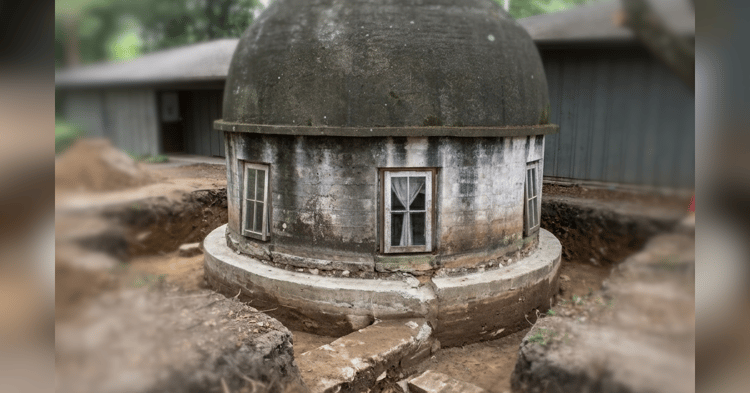
The Great Fairhope Preservation Theater: Moving a Concrete Tool Shed for Developer Profits
Leave it to small town politics to turn a terminal illness into a high-brow literary pilgrimage and a concrete parking lot obstruction into a sacred municipal emergency.
If you’ve been paying attention to local news or the solemn chatter down by the bay, you know the circus has rolled into town once again. The local self appointed cultural elite are currently wringing their hands, clutching their pearls, and opening their pocketbooks over the relocation of the famous Hermit Hut, or the “Round House,” if you prefer the dignified title meant to make a six-inch-thick pile of poured cement sound like architectural heritage.
The story being sold to the public is pure Hollywood fairytale, cooked up in large part by a popular fictionalized book. In the sanitized, romanticized version of events that the community loves to tell itself, Henry Stuart was a mysterious, solitary philosopher, a Southern Thoreau who retreated into nature to commune with Tolstoy, build a handcrafted sanctuary, and ponder the cosmos in quiet dignity.
Ask anyone around the county whose family has been here for decades, and they’ll give you the real story. Henry Stuart wasn’t a romantic poet. He was an oddball hermit with a bad set of lungs. Back in the twenties, a diagnosis of tuberculosis was a literal death sentence. It wasn’t uncommon for folks facing a terminal, highly contagious disease to go through a period of deep self-reflection or pull back from society. Fear of spreading a lethal lung infection and the harsh social quarantine that came with it tends to make a hermit out of a man real fast.
Stuart bought a patch of land, mixed up some gravel, mud, and cement, and put together a shelter. Let’s call it what it actually is: a glorified concrete tool shed. It looks like somebody sawed the top off a farm silo, dropped it onto a slab, cut out two window holes, and called it a day. Any half-decent handyman with a wheelbarrow and three bags of pre-mix could replicate the thing in a weekend.
Yet, the local establishment, being the wonderfully elitist bubble that it is, cannot simply let a concrete hut be an old eccentric’s isolation ward. No, it has to be sanctified. The town wrapped its collective identity around this fictionalized romance, turning a simple contagious-disease quarantine shelter into a shrine of historical significance.
Which brings us to the present spectacle: the grand relocation to a nearby public nature preserve.
You’d think the municipality was preparing to move the Tsar of Russia’s summer palace. They’ve assembled a small army of specialists, engineers, and heavy machinery operators. They’re running routes, measuring tree overhangs, and reportedly threatening to sacrifice a massive, decades-old oak tree in the process just to squeeze this lump of concrete down the road.
And who is paying for this elaborate municipal circus? Not the commercial real estate owner who actually holds the title to the land.
The hut sits right in the middle of a commercial parking lot. Now, in a normal world governed by basic logic and clear business ethics, if a private property owner has an unwanted structure sitting right in the middle of prime commercial real estate that they want to develop, they pay to move it or demo it. If a developer wanted the hut off their dirt to clear space for a new strip mall, gas station, or high-value tenant, all they should have to do is walk up to the city council and say, “Look, this thing is in my way. I can’t build or sell this parking lot space with this block of cement in the middle. If I pay to haul it off, will y’all give it a home on city land?”
If the developer paid for it, that would be a completely different story.
Instead, we are treated to the ultimate local political maneuver. A hypothetical scenario where private developers and local officials sit around over drinks at a local country club lounge, coming up with a scheme to get the public to bankroll private site clearance under the guise of “saving history.”
The city council and local organizers have worked the community into such a frenzy of historical nostalgia that well-meaning citizens are willingly donating their hard-earned money to move a private obstacle off private land. Once that hunk of concrete is cleared, don’t be surprised if the existing office tenants get their notices so the entire parcel can be redeveloped into high-density commercial space.
The taxpayers and donors shoulder the bill, the city spends administrative time and resources, a historic tree gets put on the chopping block, and private enterprise gets a clean, prime piece of cleared real estate ready for the next lucrative project, completely free of charge.
Furthermore, moving a structure out of its original location strips away its true historical context. Stuart placed it on that specific piece of land for a reason, and dragging it to a new location diminishes whatever genuine history it had left.
The real kick in the teeth is what happens when this concrete silo top actually hits the road. Moving a brittle, century-old poured-concrete shell isn’t like moving a wooden cabin. There is a very real chance the entire thing cracks into gravel halfway down the road. And when it crumbles, who gets hung out to dry? The poor, well-meaning locals who donated out of their fixed incomes to preserve a piece of folklore, while the real estate machinery keeps on rolling without missing a beat.
It’s local political maneuverings at their finest. Private gain wrapped tightly in public virtue. After all, that man’s fame ends at Fairhope city limits.